
Why we chose you
We are selective. We partner with leaders ready to redefine their industry with AI.
The market is
flooded with
AI playbooks.
Every major
consultancy has
one, and they all
echo the same
advice: move fast,
optimize, and stay
balanced.
However, these standard approaches are built on a flaw: they treat AI as a simple tool for process efficiency. They ignore the reality that AI is a general-purpose technology requiring a fundamental rethink of how a business operates and grows.
For corporates, the trap is comfort. Large budgets and legacy systems make even small wins feel like progress. The standard playbook feels safe—it buys time and ticks the "innovation" box without disrupting the core. The result is scattered pilots and negligible impact.
For scale-ups, the trap is existential. You lack the luxury of time or budget for half-measures. Incremental changes burn resources while leaving the door open for AI-native competitors built for speed and automation. You need focus and bold bets. AI shouldn't just be a tool you use; it must be the operating system you grow on.
We provide the alternative. We partner with leaders to place concentrated bets that rewire the organization. We don’t chase marginal lifts; we build structural, defensible advantages through data, proprietary workflows, and market positioning.
These are the exact moats investors look for in high-growth companies, and they will determine which incumbents survive the next shift.
The market will eventually force everyone out of the "AI as a tool" mindset. The only question is whether you make that shift on your own terms, or wait until your competitors make it for you.
Enterprise AI usually fails for one reason: companies treat it as software rather than strategy. Until you view AI as a foundational technology, you will continue producing pilots rather than business transformation.
We help companies outgrow their peers
by becoming AI-first sooner
Watch how we transition organizations from traditional headcount-heavy scale to lean, AI-native architectures.
Why shift to
AI-first
A strategic redefinition of value creation:You don't need headcount or massive
capital to scale. You need AI at the core
AI has matured at unprecedented speed and will now rapidly become the core infrastructure of businesses. Foundation models, autonomous agents, and low-code AI tools have dramatically lowered the barriers to entry and scale. Today, small teams can build global businesses, automate entire workflows, and deliver hyper-personalized services that outpace traditional players.
This new breed of AI-native businesses is proving that you don't need headcount or massive capital to scale. You need AI at the core. According to the Lean AI Native Companies Leaderboard, the most successful early-stage AI-native startups:
- Operate with teams under 50 people
- Generate $2.5M+ in revenue per employee
- Achieve valuations exceeding $117M per employee





Leading AI companies in terms of revenue or valuation per head
These companies are structured around AI from day one, with architecture, workflows, and business models designed for scale, speed, and autonomy.
While large corporates may feel overwhelmed by the idea of "AI-first," the lesson is just as urgent for them: real value doesn't come from layering AI on top of legacy processes, but from doing the harder work of rethinking how you operate, design, and grow with AI at the core.
Forbes, Business Insider, and Seedtable consistently spotlight these companies as case studies in what's possible when you remove organizational drag and lean into AI as your foundational layer.
From linear to exponential:AI-first companies don’t just speed up tasks. Theyredefine the work itself and scale through intelligence.

Built for adaptation:
AI-first companies are structurally designed to evolve.
- Instant reconfiguration:Workflows change by updating agent logic, not by retraining an entire workforce.
- Embedded intelligence:Systems react instantly to market signals and operational anomalies.
- Modular operations:Rigid hierarchies are replaced by orchestrated systems that scale up or down as needed.
Example: If regulations change, an AI-first insurer can update policy logic in hours via prompt changes and model instructions, while traditional insurers require retraining, compliance reviews, and months of rollout.
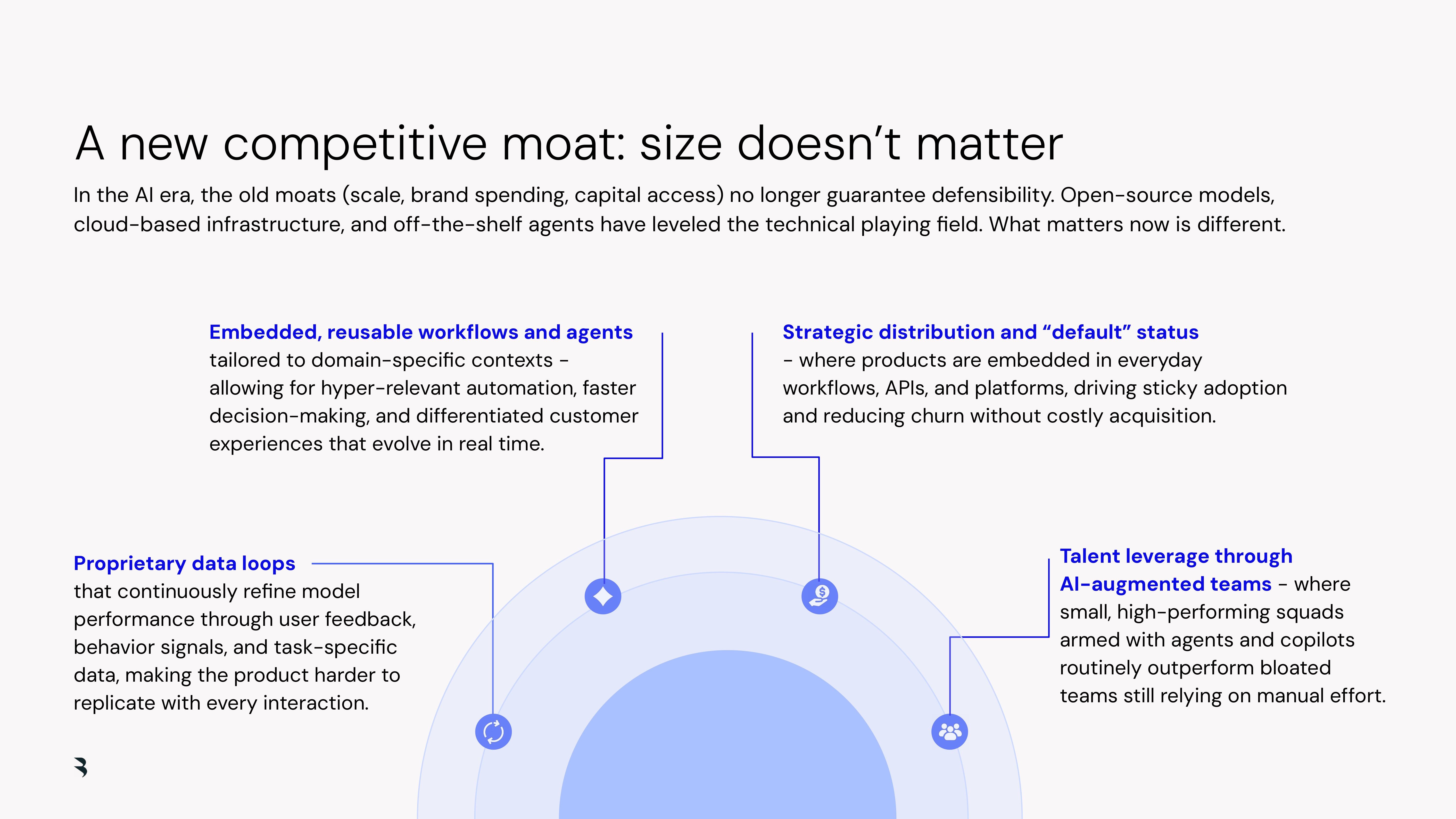
A new competitive moat:
size doesn't matter
In the AI era, the old moats (scale, brand spending, capital access) no longer guarantee defensibility. Open-source models, cloud-based infrastructure, and off-the-shelf agents have leveled the technical playing field. What matters now is different.
Proprietary data loops
that continuously refine model performance through user feedback, behavior signals, and task-specific data, making the product harder to replicate with every interaction.
Embedded, reusable workflows and agents
tailored to domain-specific contexts – allowing for hyper-relevant automation, faster decision-making, and differentiated customer experiences that evolve in real time.
Strategic distribution and "default" status
– where products are embedded in everyday workflows, APIs, and platforms, driving sticky adoption and reducing churn without costly acquisition.
Talent leverage through AI-augmented teams
– where small, high-performing squads armed with agents and copilots routinely outperform bloated teams still relying on manual effort.
A new competitive moat: size doesn't matter
In the AI era, the old moats (scale, brand spending, capital access) no longer guarantee defensibility. Open-source models, cloud-based infrastructure, and off-the-shelf agents have leveled the technical playing field. What matters now is different.
AI-first companies are built on systems that improve with use, deepen with scale, and get harder to copy the more they're used.
Proprietary
data loops
Feedback integration deepens model defensibility
Harvey,
Hippocratic
Context-specific agents & workflows
Tailored automations outperform general tools
Magic,
Cursor
Embedded distribution
Stickiness via integrations
Hugging Face,
OpenAI x MSFT
Talent
leverage
Revenue per employee >$2M in top AI-native startups
Lean AI
Leaderboard
Non-linear advantage
System improves with use, increasing gap over time
Vellum,
Perplexity
Why now? The timing has never been more urgent



"The companies that will dominate the next decade aren't just adopting AI – they're built around it."
Where AI-native wins are showing
The market isn't waiting and we believe this is the inflection point. In two years, companies will either be scaling with AI, or watching their competitors do it. The opportunity to lead is here. But it won't stay open for long.
AI-first companies are already locking in early-mover advantages by:
- Accumulating proprietary data that improves their systems with every use
- Building reusable workflows and agents that scale across functions
- Normalizing AI-native ways of working before inertia makes change harder
- Securing executive buy-in and market momentum
- Institutionalizing fluency while others are still running pilots
AI-native
wins
Education
AI tutors and learning companions are scaling personalized instruction at fractional costs.
Consulting
Lean AI firms are undercutting incumbents with agent-led research and strategy synthesis.
Legal
In legal, AI-native startups are displacing traditional firms by offering 10x faster services with better accuracy.
Education
AI tutors and learning companions are scaling personalized instruction at fractional costs.
Consulting
Lean AI firms are undercutting incumbents with agent-led research and strategy synthesis.
Legal
In legal, AI-native startups are displacing traditional firms by offering 10x faster services with better accuracy.
The 5 pillars of
organizational
reinvention
From traditional to AI-first:
The 5 pillars of organizational reinvention
Becoming an AI-first company requires a deep, structural shift, not just in technology adoption, but in how the business operates, decides & grows. Here is a comparison across five strategic pillars that highlight the seismic difference between the old model & the AI-first model.
Growth
Add people to scale. Value grows linearly.
Scale through automation and leverage. Value grows exponentially.
Innovation
Human-led R&D
AI-generated insights and co-creation
Efficiency
Optimize processes
Rebuild workflows with agents at core
Resilience
React to change
Anticipate and adapt autonomously
Spent
3-5% spent on tech
30-50% spent on tech
Growth
Add people to scale. Value grows linearly.
Scale through automation and leverage. Value grows exponentially.
Innovation
Human-led R&D
AI-generated insights and co-creation
Efficiency
Optimize processes
Rebuild workflows with agents at core
Resilience
React to change
Anticipate and adapt autonomously
Spent
3-5% spent on tech
30-50% spent on tech
AI-enabled vs. AI-first:
Two very different paths
AI-enabled companies
adopt fast, find efficiencies, and strike a balance – but often spread resources thin, retrofit old logic, and stall in pilot purgatory.
AI-first companies
rethink how they grow, operate, and compete, building with AI at the core to unlock nonlinear gains and strategic defensibility.
Core design
shifts
The organization evolves from being people-powered
to AI-orchestrated
Three tracks
of AI-first
transformation
To move from vision to execution, organizations need more than ambition. They need a practical system for reimagining how value is created, how work gets done, and how that work scales across the enterprise.
We call these the three tracks of AI-first transformation:

Track 1: Strategic reinvention
(Top-down, moat-focused)
Reimagine your core business model and strategic edge for an AI-native world: where you play, how you win, and what sets you apart. Reinvention means rethinking the ‘why’ and the ‘where’, challenging the very logic of how you create value in the age of intelligent systems.
This is top-down, core-focused, and future-back. It’s about:
Reinventing how your company operates, creates and captures value in an AI-native world
Making deliberate, concentrated bets to protect or reshape your core strategic advantage
Asking: “How would an AI-native disruptor make our core business obsolete?” and then building from there
Outcomes often include:
A new product/service logic
A redefined operating model
A proprietary data flywheel or agentic system
A hard-to-copy, defensible moat

This is where tools like the AI Opportunity Mapping, Use Case Canvas, and Moat Reflection templates play a central role.
Case: A client in healthcare insurance
Challenge
A mid-sized health insurer realized that incremental AI investments, such as automating claim handling and adding chatbots, weren’t enough to defend their market position. They initiated a strategic reinvention track to rethink their core value proposition.
Strategy and reinvention
Launch a subscription-based preventative care product, powered by AI agents that monitor behavior and nudge healthier decisions.
Build a proprietary data loop to continuously improve underwriting and personalize care recommendations.
This repositioned the company as a proactive health partner, not just a claims processor, creating a defensible moat around behavioral data and engagement.
Key outcomes:
New product line with $80M growth potential
Proprietary data asset built from real-time health signals
Moat strengthened through predictive personalization and early intervention

Track 2: Operational redesign
(Bottom-up, workflow-focused, efficiency-driven)
Redesign is about rethinking the how: transforming the flow of work to unlock speed, productivity, and new patterns of human-machine collaboration.
This is bottom-up, execution-focused, and inside-out. It’s about:
Systematically rebuilding workflows, roles, and tools with AI embedded at the core
Using zero-based redesign to challenge old assumptions and unlock non-linear productivity
Reclassifying who does what (AI, human, hybrid) and identifying reusable agent patterns
Outcomes often include:
New process flows
Ownership heatmaps
Role redefinitions and upskilling tracks
AI orchestration and guardrails

This is where our Zero-Based Workflow Design, Ownership Heatmap, and Before/After Mapping tools come in.
Case: A client in logistics
Challenge
A global logistics leader struggled with inefficiencies in client onboarding and shipment quoting. The process spanned 9 steps, 6 separate systems, and manual handoffs across sales, legal, and operations. While AI tools were deployed in isolated departments, the end-to-end workflow remained fragmented and costly.
Strategy and reinvention
An AI-native flow where agents generate quotes, pre-approve standard contracts, trigger shipment bookings, and escalate only exceptions.
Ownership heatmaps clarified roles, showing that 70% of steps could be fully automated or hybridized.
New roles like “Agent Supervisor” and “Prompt Curator” were introduced. Within weeks, cycle time dropped from 5 days to under 2 hours.
Key outcomes:
80% reduction in onboarding time
60% cost reduction per quote
Human roles elevated to handle complex edge cases and relationship management

Track 3: AI-first operating model
(Systemic, integrative, and future-proofing)
Embed and scale transformation by redesigning the enterprise’s structure, governance, and capabilities. This connects the ambition of reinvention with the execution of redesign, making AI-native ways of working durable, repeatable, and enterprise-wide.
It’s about:
Designing an operating model that can continuously learn, adapt, and scale AI across the enterprise
Ensuring AI-native ways of working become sustainable, not situational
Turning repeatable success into a coordinated system of work – spanning teams, domains, and functions
Outcomes often include:
New governance and investment mechanisms for AI
Scalable capability backbone
AI-native culture with fluency, clear roles, and incentives built into daily work
Adaptive learning loop to track adoption, cost, risk, and impact

This is where tools like the AI Operating Model Canvas, AI Governance Framework, Org Design Patterns, and Fluency & Enablement Tracks come into play.
Case: A client in fintech
Challenge
A fintech company was running dozens of AI pilots, but value wasn’t compounding. Costs crept up, teams duplicated tools, and experiments stayed stuck in silos. Leadership realized the problem wasn’t lack of adoption, but lack of orchestration.
Strategy and reinvention
Key outcomes:
3x reuse of AI workflows via internal marketplace
40% fewer duplicative pilots
Enterprise-wide AI fluency tracked and improved quarterly

Your 90-day
AI-first
transformation
roadmap
Your 90-day AI-first
transformation roadmap
This roadmap helps you move from vision to velocity in just three months – with early wins, structural enablers, and a system that scales.
Phase 1
Align, Focus & Rationalize (Weeks 1–3)
Phase 2
Redesign & Pilot (Weeks 4–7)
Phase 3
Codify & Scale (Weeks 8–12)
Phase 1
Align, Focus &
Rationalize
(Weeks 1–3)
Phase 2
Redesign & Pilot
(Weeks 4–7)
Phase 3
Codify & Scale
(Weeks 8–12)
By day 90 you've built:
Phase 1: Align, Focus & Rationalize
(Weeks 1–3)
Goal:
Establish a bold AI-first ambition, surface your most strategic opportunities, and clean up your current AI portfolio to focus on what truly aligns.
Outputs
- →Bold AI-first ambition & north star commitment
- →Strategic lever map defining where AI can reshape advantage
- →Rationalized AI portfolio (continue/pivot/kill matrix)
- →Prioritized domain focus for redesign (2–3 to start)
- →Taskforce activated with execution mandate
Tips & Tricks for Rationalization:
- →Be honest: What was built just to “do something with AI”?
- →Use your AI-first ambition as the filter. If it doesn’t accelerate it, cut it.
- →Expect to retire or repurpose 40–60% of the existing portfolio – this isn’t failure; it’s focus.
- →Socialize this as “freeing up capacity” to double down on what matters.
Key activities
Phase 2: Redesign & Pilot
(Weeks 4–7)
Goal:
Run rapid AI-native redesigns of high-friction workflows, supported by early governance and clear ownership.
Outputs
- →3–5 AI-native workflows live or in test
- →Ownership heatmaps and swimlanes for orchestration
- →Centralized experimentation registry
- →Tool usage dashboard and license policy live
- →Teams trained on co-pilots with prompt libraries
Key activities
Phase 3: Codify & Scale
(Weeks 8–12)
Goal:
Move from experiments to systems. Embed new ways of working, redefine roles, and build your AI operating model.
Outputs
- →AI-first role pilots embedded in 2–3 teams
- →AI operating model visual shared org-wide
- →Marketplace with 10+ reusable workflows/prompts
- →Governance framework, spend guardrails, role clarity
- →Internal dashboard with early business impact
Key activities
Built-in momentum for
beyond day 90
- →Reuse over reinvention:
Shared marketplace, prompt library, and experiment registry prevent duplication.
- →Flywheel effect:
Success stories feed into exec reviews, inspire new sprints, and fuel budget reallocation.
- →Role readiness:
Pilot teams become talent accelerators for new capability tracks.
- →Execution rhythm:
Lightweight rituals (weekly demos, retros, AI clinics) build habit and help scale without bureaucracy.


Key takeaways
Becoming AI-first is a strategic shift, not a tooling upgrade.
AI rewrites how value is created, decisions are made, and work is organized.
Capturing real value requires redesigning the system itself
Transformation happens across three interconnected tracks.
Strategic reinvention, operational redesign, and an AI-first operating model must move in sync to turn isolated wins into structural advantage.

Ready to become an
AI-first company?
We help you set an integrated strategy that lets you capture the value of AI, both in the short and long term.
AI reinvention sprint
Define where AI can reshape your business model and create moats competitors can't copy. In 4–6 weeks, we help leadership align on bold, future-back bets that anchor AI transformation in strategy, not scattered pilots.
Zero-based workflow redesign sprints
Rebuild your most critical workflows from scratch with AI at the core. In just a few weeks, we transform high-friction processes into AI-native flows that cut cost, speed up execution, and prove what 80% AI-executed really looks like.
AI-first operating model blueprint
Codify the system that makes AI adoption scalable and safe. In 10–12 weeks, we design governance guardrails, role taxonomies, and capability roadmaps so your organization moves from isolated wins to a repeatable AI-first model.